
The Door Won't Budge — But It's 58 Degrees Outside
You hit the wall button on a cool November morning, the kind where a cold front finally pushed the humidity down overnight, and instead of lifting smoothly, your garage door groans, shudders, or stops halfway. Sometimes the bottom edge looks like it's glued to the slab for a second before it breaks free. The opener motor sounds like it's working harder than usual. If you're lifting it manually, it feels heavier than it should, almost like something is holding the bottom rail down.
In colder states, this is a classic case of a door frozen to the driveway. Fort Myers doesn't get hard freezes, so it's not ice — but the symptoms look nearly identical, and the underlying causes are just as mechanical. Overnight temperature drops combined with our heavy humidity create condensation on the slab and the door's rubber seal, and that dampness, paired with months of salt air and summer moisture exposure, is usually what's making the door stick or strain.
What a Technician Checks, in Order
1. The Bottom Seal and Weatherstripping
This is the first thing worth checking because it's the most visible. After a humid night followed by a cool morning, the rubber astragal along the bottom of the door can press flat against a damp concrete slab and create a light suction seal. If the weatherstrip has also gotten brittle or cracked from months of summer UV exposure, it's more likely to catch on the slab instead of releasing cleanly. The fix is straightforward: inspect the seal for cracking or flattening, and replace it if it's no longer flexible. A fresh, pliable seal breaks contact with the ground easily and also does a better job keeping wind-driven rain out during storm season.
2. Track Alignment and Rust Buildup
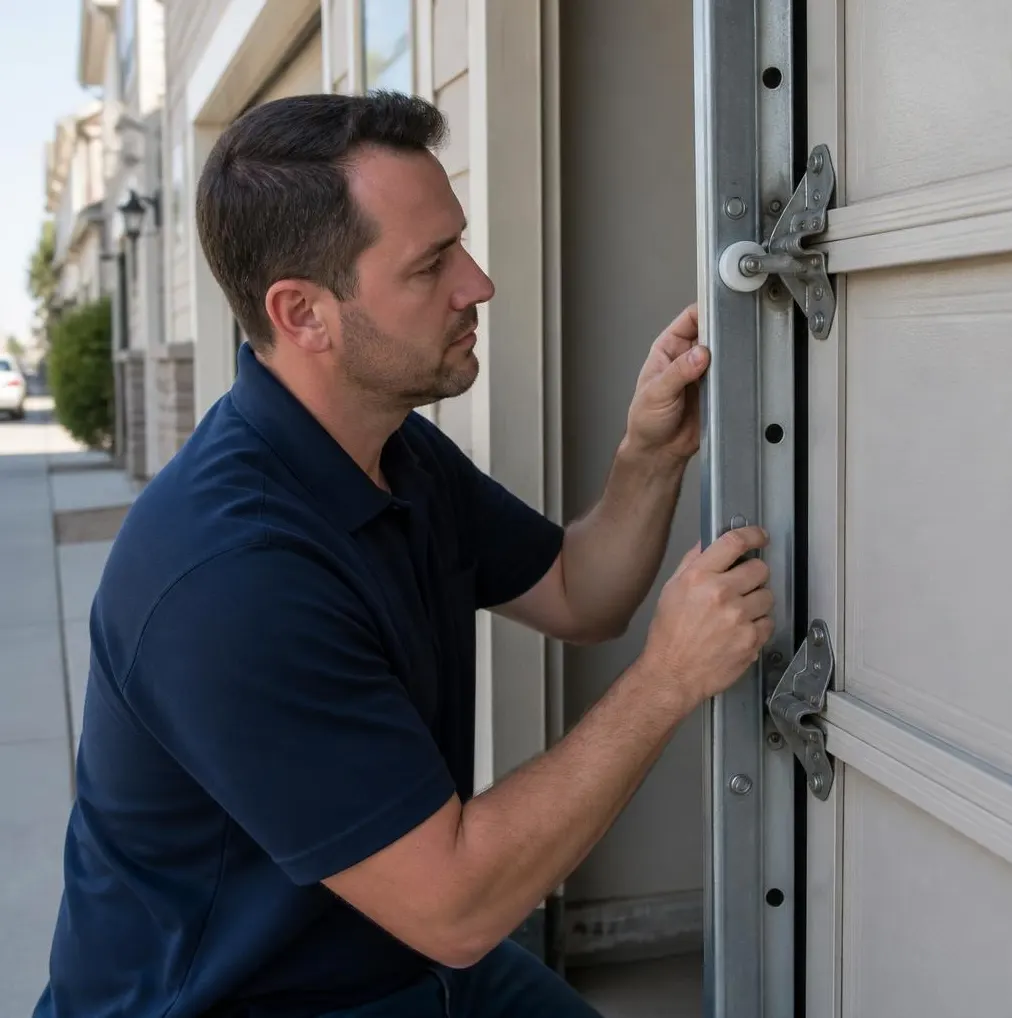
Next, a technician looks at the vertical and horizontal tracks, especially on homes closer to the coast in places like Bonita Springs or Cape Coral where salt air accelerates corrosion. Surface rust and accumulated grit can create just enough friction to make the door hesitate or jerk as the rollers pass over rough spots. This gets checked by running the door manually (with the opener disconnected) and watching for binding points. The fix is cleaning the tracks, confirming they're still plumb and properly spaced, and applying a fresh coat of lubricant made for garage door hardware rather than general household oil, which attracts dust and grime.
3. Rollers and Hinges
Old grease on rollers and hinge pins thickens slightly as temperatures drop, and after a humid summer, that grease often has moisture and dust mixed into it already. Nylon rollers can also develop hairline cracks from heat cycling, while steel rollers rust from months of humidity. A technician checks each roller by hand for play, cracking, or flat spots, and listens for grinding at the hinges. Worn rollers get replaced, and everything else gets cleaned and relubricated with a silicone-based product that holds up better in humid conditions than petroleum-based grease.
4. Springs and Cable Tension
Torsion springs lose a small amount of tension as metal contracts in cooler air, and if those springs already have surface rust from the salt air and a long, humid storm season, that tension loss is more pronounced. This shows up as a door that feels unusually heavy to lift, or an opener that strains and sometimes reverses before finishing its cycle. This is checked by disconnecting the opener and manually lifting the door halfway to see if it holds position on its own — if it drops, the springs are losing their balance. Rusted or fatigued springs get replaced rather than patched, since a spring under uneven tension is also a safety risk.
5. Opener Settings and the Photo-Eye Sensors
Finally, a technician checks the opener itself. Chain and belt tension can shift slightly with temperature changes, and force or limit settings that were fine in August can cause the door to stall or reverse once conditions change. The photo-eye sensors near the bottom of the tracks are also worth a look, since morning condensation can fog the lenses and cause the door to behave erratically, which homeowners sometimes mistake for the door being physically stuck. Cleaning the lenses, confirming alignment, and resetting force limits usually resolves this.
When to Call Fort Myers Garage & Gate
If cleaning the track and lubricating the rollers doesn't solve it, or if the door feels heavy and the springs look rusted or stretched, it's time to call in a professional rather than keep forcing the opener to push through resistance. Our Spring Replacement service addresses the tension loss and corrosion that's common after a long, humid Southwest Florida season, and our Maintenance & Tune-Ups cover the full inspection — tracks, rollers, hinges, seals, and opener settings — so small issues get caught before they turn into a dead opener motor or a door that won't open at all.
If your garage door in Fort Myers is sticking, straining, or hesitating on cool mornings, give Fort Myers Garage & Gate a call — we'll find the real cause and get it moving smoothly again.